Überwachung einer BMPC
- Die BMPC ist eine Überwachungseinheit!
- BMPC = Bruker Magnet Pump Control
Was soll das?
BMPCII (geöffnet)
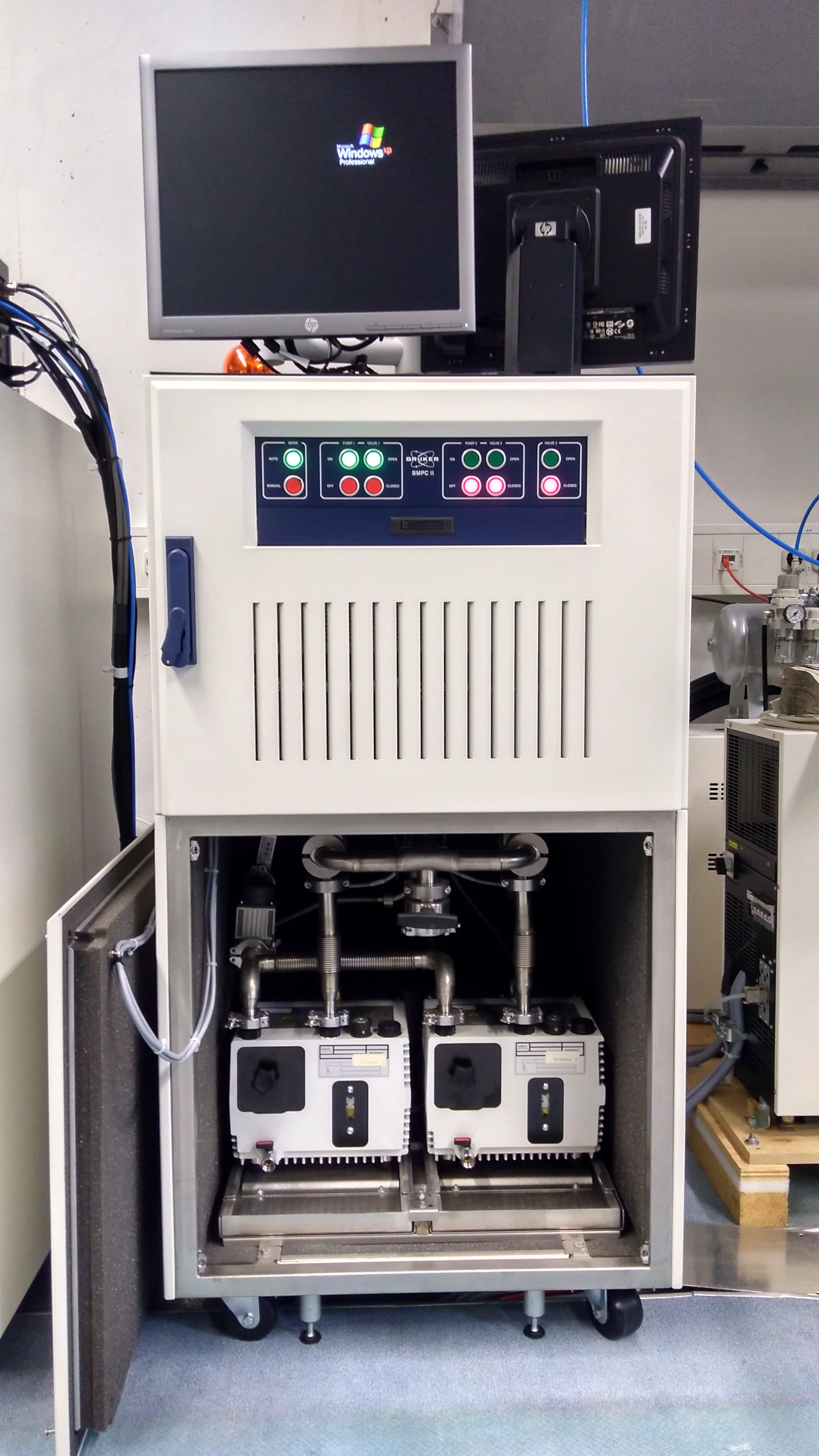
- Eine der beiden Vakuumpumpen (meist die linke) pumpt Heliumgas aus dem Magneten
- Durch Verdampfungskühlung wird die Temperatur des flüssigen Heliums auf 2.17 K gesenkt
- Ein Ausfall der Kühlung würde zum Magnetquench führen
- Die Funktion der Vakuumpumpe wird permanent überwacht
- Überprüfte Parameter:
- Temperatur der Magnetspule
- Angepumpte Menge an Heliumgas
- Stromaufnahme der Vakuumpumpe
- Druck in der Abpumpleitung
- Zustand der USV
- Verhalten bei Fehlern:
Aufgaben einer BMPC (Flexbox)
BMPCII (geöffnet)
- Eine der beiden Vakuumpumpen (meist die linke) pumpt Heliumgas aus dem Magneten
- Durch Verdampfungskühlung wird die Temperatur des flüssigen Heliums auf 2.17 K gesenkt
- Ein Ausfall der Kühlung würde zum Magnetquench führen
- Die Funktion der Vakuumpumpe wird permanent überwacht
- Überprüfte Parameter:
- Temperatur der Magnetspule
- Angepumpte Menge an Heliumgas
- Stromaufnahme der Vakuumpumpe
- Druck in der Abpumpleitung
- Zustand der USV
- Verhalten bei Fehlern:
Das Monitoringsystem benötigt natürlich zwei Netzwerkanschlüsse

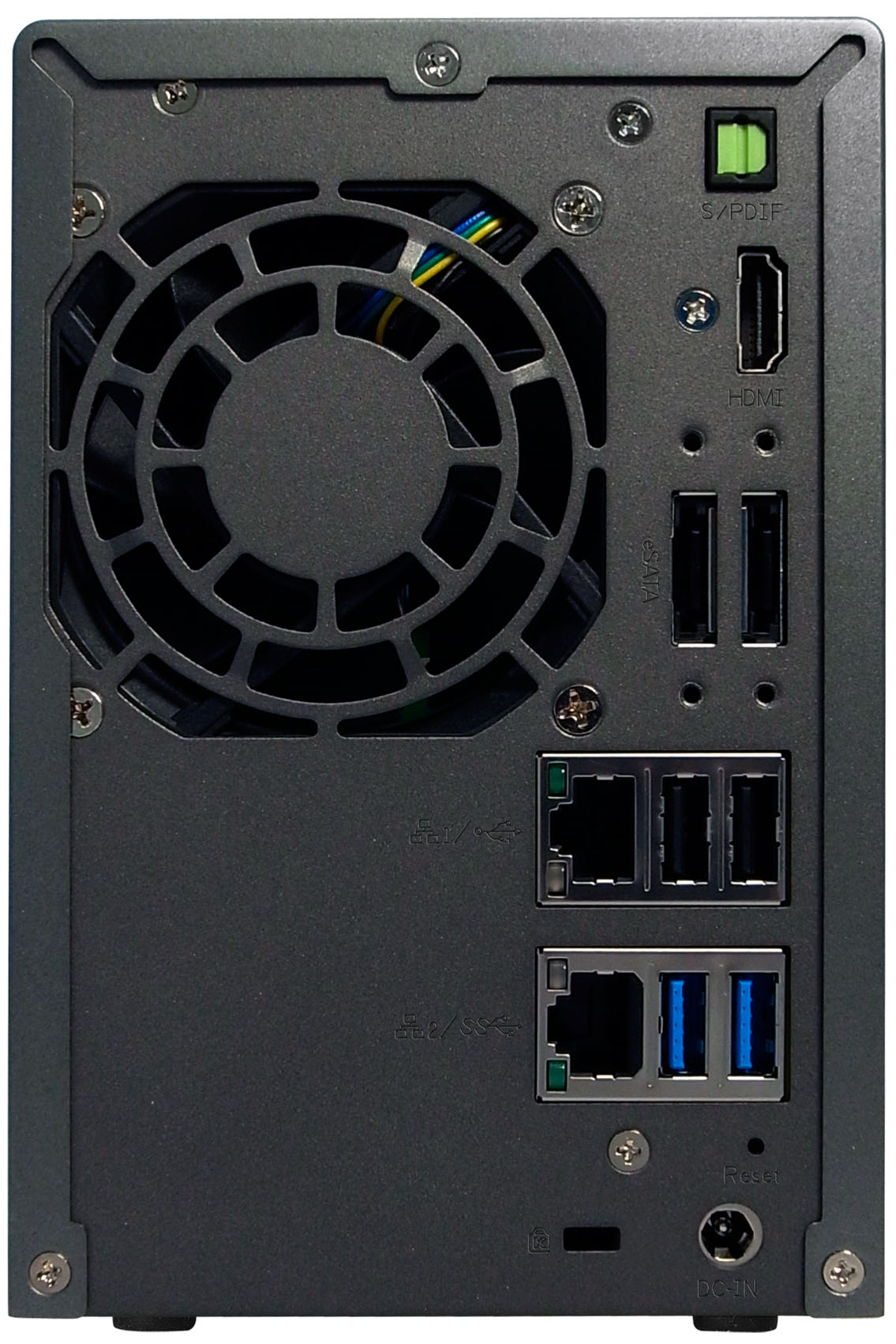


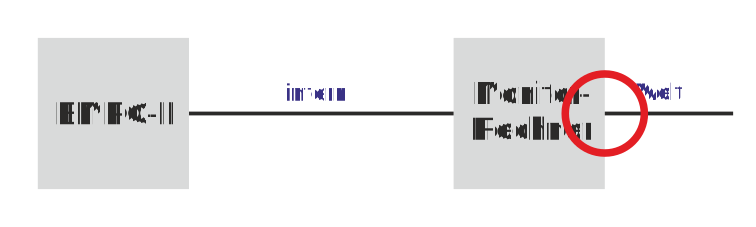
enp0s25: flags=4163  mtu 1500
        inet 129.187.121.154  netmask 255.255.255.0  broadcast 129.187.121.255
        inet6 fe80::baac:6fff:fe2a:97c0  prefixlen 64  scopeid 0x20
        inet6 2001:4ca0:2611:2:baac:6fff:fe2a:97c0  prefixlen 64  scopeid 0x0
ether b8:ac:6f:2a:97:c0 txqueuelen 1000 (Ethernet) 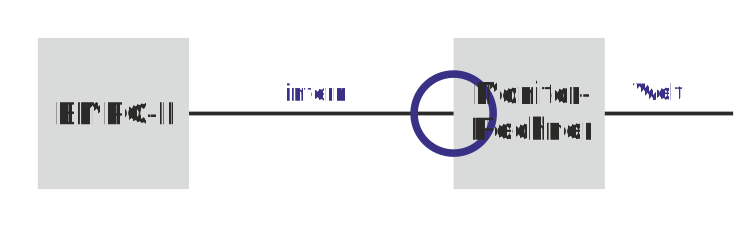
enp4s2: flags=4163  mtu 1500
        inet 10.16.5.1  netmask 255.255.255.0  broadcast 10.16.5.255
        inet6 fe80::f907:680a:89f9:7b67  prefixlen 64  scopeid 0x20
ether 3c:1e:04:47:1a:db txqueuelen 1000 (Ethernet) - Number of nodes: $N$
- Number of links: $L$
Adjacency matrix $A = \begin{bmatrix} 0 & 1 & 1 & 1 & 1 & 0 \\ 1 & 0 & 0 & 0 & 1 & 1 \\ 1 & 0 & 0 & 1 & 1 & 0 \\ 1 & 0 & 1 & 0 & 0 & 0 \\ 1 & 1 & 1 & 0 & 0 & 1 \\ 0 & 1 & 0 & 0 & 1 & 0 \\ \end{bmatrix}$
Laplacian matrix $Q = \begin{bmatrix} 4 & -1 & -1 & -1 & -1 & 0 \\ -1 & 3 & 0 & 0 & -1 & -1 \\ -1 & 0 & 3 & 1 & -1 & 0 \\ -1 & 0 & -1 & 2 & 0 & 0 \\ -1 & -1 & -1 & 0 & 4 & -1 \\ 0 & -1 & 0 & 0 & -1 & 2 \\ \end{bmatrix}$

In this example: $N = 6$ and $L = 9$.
How to count the number of node-disjoint triangles?
								def triangles(G, A):
								   triangles = 0
								   for n1, n2, n3 in zip(G.nodes(), G.nodes(), G.nodes()):
								      if (A[n1,n2] and A[n2,n3] and A[n3,n1]):
								         triangles += 1
								   return triangles / 6
Algorithms need exhaustive enumeration.

In this example we have 4 triangles.
Spectral decomposition of the Adjacency Matrix:
$A = X \begin{bmatrix} \lambda_1 & & 0 \\ & \ddots & \\ 0 & & \lambda_{N} \\ \end{bmatrix} X^T $
$\lambda_1 \geq \ldots \geq \lambda_{N}$ are the eigenvalues of the network.
$\mu_1 \geq \ldots \geq \mu_{N}$ are the Laplacian eigenvalues
(We will need them later)
In this example the eigenvalues are:
$3.182, 1.247, -1.802,$
$-1.588,-0.445, -0.594$
Random network
Barbasi-Albert ($N$ = 5000)


Network of AS
tech-WHOIS, Mahadevan, P., Krioukov, D. et al. ($N$ = 7476)


Can we extract the hidden relations between the properties of a network and their corresponding spectra?
Rediscover a known formula for a network property
Discover an unknown formula for a network property
Length of the longest of all shortest paths in a network.
								def diameter(G):
								    diam = 0
								    for src, dest in zip(G.nodes(), G.nodes()):
								        path = shortest_path(src, dest)
								        diam = max(len(path), diam)
								    return diam
The exact formula for the network diameter $\rho$ implies this exhaustive enumeration:
$$\rho = \max\limits_{src, dest} \min dist(src, dest)$$

In this example the diameter is 3.
Triangles $\blacktriangle$

Diameter $\rho$

Augmented path graphs

|
$\rho = 11$ |

|
$\rho = 10$ |

|
$\rho = 8$ |
- sparse networks
- varies $\rho$ by keeping $N$ constant
Barbell graphs
 |
$\rho = 6$ |
 |
$\rho = 8$ |
 |
$\rho = 8$ |
- dense networks
- varies $N$ by keeping $\rho$ constant

$\begin{equation} \hat{\rho} = \frac{\log{\left (2 L \mu_{N-3} + 6 \right )} + 6}{\log{\left (L \mu_{N-3} + \sqrt{5} \sqrt{\frac{1}{\mu_{N-1}}} \right )}} + \sqrt{5} \sqrt{\frac{1}{\mu_{N-1}}} + 3 \sqrt{82} \sqrt{\frac{1}{729 L \mu_{N-2} \mu_{N-3} - 5}} \end{equation}$
Comparison to known analytical results from graph theory:
Upper bound by Chung, F.R., Faber, V. and Manteuffel, T.A.: "An Upper bound on the diameter of a graph from eigenvalues associated with its Laplacian."
(See also Van Dam, E.R., Haemers, W.H.: "Eigenvalues and the diameter of graphs.")
$\rho \leq \left\lfloor \frac{\cosh^{-1}(N-1)}{\cosh^{-1}\left(\frac{\mu_1 + \mu_{N-1}}{\mu_1 - \mu_{N-1}}\right)}\right\rfloor + 1$

| parameter | value |
|---|---|
| $N$ | 379 |
| $L$ | 914 |
| true diameter $\rho$ | 17 |
| approximated diameter $\hat{\rho}$ | 21.48 |
| upper bound | 160.09 |

ca-netscience

source: http://www.networkrepository.com
| parameter | value |
|---|---|
| $N$ | 4941 |
| $L$ | 6594 |
| true diameter $\rho$ | 46 |
| approximated diameter $\hat{\rho}$ | 97.52 |
| upper bound | 749.49 |

inf-power

source: http://www.networkrepository.com
| parameter | value |
|---|---|
| $N$ | 1458 |
| $L$ | 1948 |
| true diameter $\rho$ | 19 |
| approximated diameter $\hat{\rho}$ | 18.59 |
| upper bound | 207.52 |

bio-yeast

source: http://www.networkrepository.com
